My top 5 places to see puffins in Orkney
The quirky little bird everyone wants to see
Probably the number one question I get asked is ‘where can I see puffins?’ It’s no surprise really, these beautiful little auks have a lot to like about them, not least their multicoloured bill, resplendent in red, yellow, orange and blue during the spring and summer. Their dapper black and white plumage is complemented nicely by bright orange feet and is sure to bring a smile to your face! They have many local names including ‘Sea Coulter’ and ‘Pope’ with ‘Tammie-norrie’ by far the most commonly used.
The results of the most recent national seabird survey (2015-2021) gave a figure of 48,431 apparently occupied burrows (AOBs) for Orkney - a more accurate way of determining the population rather than just counting individual birds. So with this many puffins you would assume they are easy to see right? Well, yes and no! Unfortunately the vast majority of these birds live on Sule Skerry, a remote skerry situated 40 miles west of the Orkney mainland in the North Atlantic.
For us mere mortals without access to a private boat however there is still good news! Excluding Sule Skerry, the Orkney population was estimated to be 6,675 breeding pairs.
April is a good time to be thinking about when to start looking for puffins as birds gather just offshore from their breeding sites. They mate on the water before returning to old nest sites and will be present on the cliffs until early August when their chick fledges for a life at sea.

When is the best time to see them?
Mid April to early August
Peak time - June & July
Early in the season look offshore for rafts of puffins on the sea where they start to get into the swing of things before coming ashore to breed. Puffins pair up for life and will use that colourful bill to pair-bond. The clacking together of bills is known as ‘billing’ and can be a noisy affair with lots of comical ‘oohing’ and ‘ahhing’. I find May can sometimes feel a bit slow for sightings with the best time usually in the evening during the chick rearing period which means June and July. Often the fishing has stopped for the day and so birds gather on the cliffs of the breeding colony. Once the chick has been reared the departure of the adult birds can often be an abrupt affair with birds gone by the first week in August.

Rearing the 'puffling'
Puffins primarily nest in burrows but in some of the smaller sites they will use crevices in the rock face, often on very high cliff faces such as those found at Marwick Head. One egg is laid and will hatch sometime between 36 and 43 days having been incubated primarily by the female.
The chick will take around 40 days to fledge having hopefully been fed a nutrition rich diet of sandeels by both hard working parents. By the time it’s ready to leave the nest the ‘puffling’ will look much like the adult but with a dark face and a smaller grey beak. You can sometimes see them emerge momentarily at the burrow entrance to start wing-flapping, but they will leave the safety of the nest at dusk or night time to spend their first year at sea. It may take them 4 or 5 years ready to return as breeding birds.
Where to point your binoculars
So, where are the best places to see Puffins in Orkney? I’ll give you my top 5 spots.
Castle o Burrian, Westray
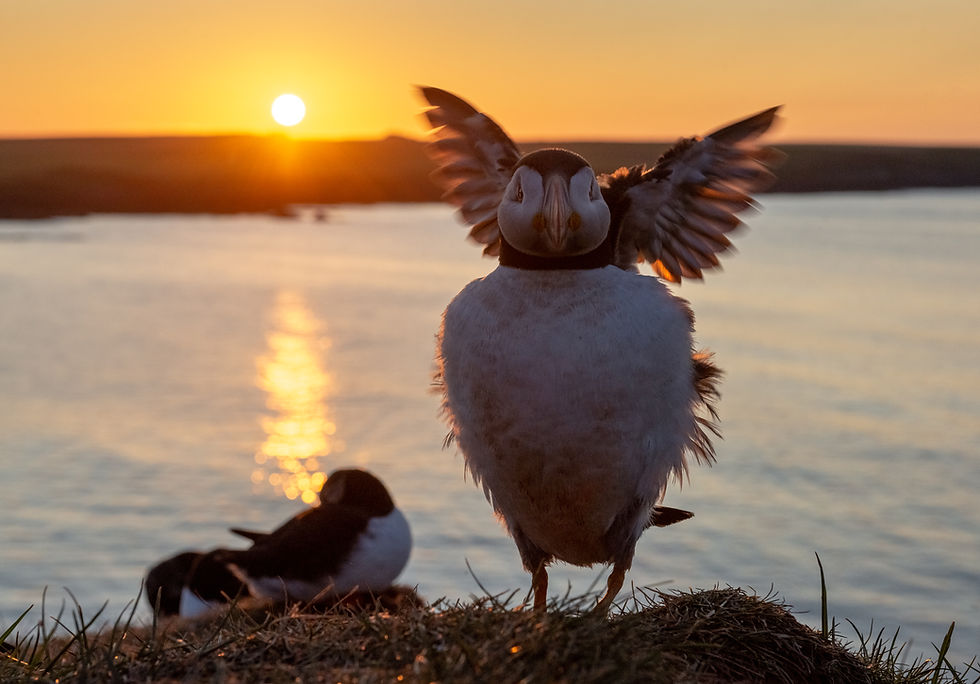
The small squat sea stack in the island of Westray is prime real estate for Orkney’s puffins and is easily our most impressive and easily accessible large colony. After a short drive from the ferry terminal the site starts with a lovely short walk along the clifftop especially during May and June where carpets of pink thrift flowers as well as red campion making beautiful colourful backdrop for photography. It is possible to get very close to the puffins here as they land on the clifftop but as always please be respectful of their space, it’s best to sit quietly and pick a spot and they’ll come to you undisturbed. In the evening it’s possible to get beautiful backlit or silhouetted images of the birds
How many puffins? Approx 500 pairs
Other species - Razorbill, fulmar, shag, great skua, arctic skua, wheatear.
How to get there - (Orkney ferry service from Kirkwall or a short flight from Kirkwall airport on the Loganair Islander service). Take the B9066 from Rapness ferry terminal and take a right at the ‘Puffins’ sign and park at the Mill car park (HY502425)

Brough of Birsay, Orkney Mainland
This small island is tidal meaning you need to get your timings right in order to visit. The walk along the causeway is only a short one but the tide rises quickly here so be sure not to get caught out! My best tip is not to think of bang on low tide as the best time to go as depending on the state of the tide (spring or neap) then the tide will very often be low enough for you to cross a good while before actual low tide, giving you plenty of time to explore the island. Do an anti-clockwise loop after the viking settlement that will eventually take you up and around the lighthouse. The best place to see puffins at close quarters is the south east corner, all with crashing waves below you. Puffins are also to be found along the west and north west corners.
How many puffins? Approx 30 pairs
Other species - Shag, common guillemot, razorbill, fulmar, eider duck, wheatear, sand martin
How to get there - Head to Birsay village on the north west corner of the Orkney mainland and head to the Point of Buckquoy car park (HY244284)

3. Marwick Head, Orkney Mainland
One of my earliest birdwatching memories comes from this magnificent RSPB reserve. Back in the 1980’s
The seabird colonies here were much bigger and so in the right wind direction you could smell the colony long before you could see it. This is a famed ‘seabird city’ and a stronghold for the common guillemot which pack tightly together on the 90 metre high cliffs. Puffins are here in small numbers and not too difficult to pick out amongst the the throng of other birds. Some of my best puffin encounters have been here in windy weather, despite their small size puffins are strong flyers and often hang in the up-draughts in these conditions. This is a place to take it all in, the dramatic scenery, the noise and smell of a large seabird colony!
How many puffins? Approx 50 pairs
Other species - Gannet, common guillemot, razorbill, fulmar, kittiwake, great skua, arctic skua, wheatear, rock pipit, jackdaw, raven, peregrine falcon.
How to get there - You have two places to choose from. Either the Marwick Bay car park (HY230241) where you can see eider ducks, turnstones and shelduck in the bay. Alternatively use the track from the Cumlaquoy car park (HY 233251).

Northside, Orkney Mainland
Northside makes up something of a Birsay puffin triangle as it’s not too far from either the Brough of Birsay or Marwick Head. This is a stunning part of the coast, looking north towards the high cliffs of Costa Head. Drive to the Northside car park (HY261 287) from the A966 road and walk towards the coast, upwards of 50-70 puffins can be seen here at the wonderfully named Whitallo point and the Loop of Crooie.
How many puffins? Approx 35 pairs
Other species - Shag, gannet, fulmar, swallow, eider duck, oystercatcher, arctic tern
How to get there - Head to Birsay village on the north west corner of the Orkney mainland and head to the Point of Buckquoy car park (HY244284)

Papa Westray
This beautiful low lying island has two main place to see puffins, North Hill RSPB reserve and Moclett in the south east of the island. North hill especially is a wonderful coastal walk and you can see puffins on the low lying cliffs on the east coast. They aren’t present in big numbers but add to the experience of a day spent in the maritime heath habitat. The surrounding waters are an MPA (Marine Protected Area) for another auk species, the black guillemot, which you’ll see flying quickly past between feeding grounds and their nest sites, usually in boulder fields.
How many puffins? Approx 30-40 pairs
Other species - Black guillemot, common guillemot, razorbill, fulmar, great skua, arctic skua.
How to get there - (Orkney ferry service from Kirkwall to Westray then the foot passenger boat to Papay, a two day a week service runs from Kirkwall to Papay direct or a short flight from Kirkwall airport on the Loganair Islander service). Once in Papa Westray for North Hill follow the road 3km north of the airfield and for Moclett follow the coast around to the east from Moclett pier.

Off the beaten track
There are of course other sites where puffins breed, in fact most of the island have a small colony or two. Of the larger islands, Hoy, Stronsay, Flotta, Shapinsay and even low lying Sanday have puffins. Larger numbers are to be found on the uninhabited remoter islands of Swona and Copinsay but they of course require more effort to get to. Orca ventures run boat trips to Swona during the summer months.
What to bring?
A telescope can be handy at Marwick Head to pick out the puffins on the lower slopes of the cliffs. Otherwise binoculars are fine and of course sturdy shoes and warm clothing are a must.
Lastly, whilst we want you to enjoy seeing these characterful little birds no picture of a puffin is worth risking your safety for. The cliffs often have overhangs and if a site says ‘dangerous cliffs’ it really means they are!
Why don’t you join me for a relaxed day watching these charismatic seabirds - you can book a day with me by clicking below. Tea/coffee and plenty of biscuits are provided!
On my Orkney wildlife day tour I make a point of looking for puffins and take you to the best sites to see this colourful little seabird. I can also organise a day in Westray, this can also be combined with a trip to Papa Westray. In July I will also be running dedicated days to photograph puffins and gannets in Westray, please contact me via info@orkneynature if you would like to enquire, places are limited to 3 people per tour.